
Check out how much effort goes into designing a park for public use. Landscape architects research access, circulation for pedestrians, drainage, vegetation, parking, lighting, playground layout, and how different groups will be able to share the space. But one of the most frequently utilized structures that are located on the property could often be considered an off-the-shelf item.
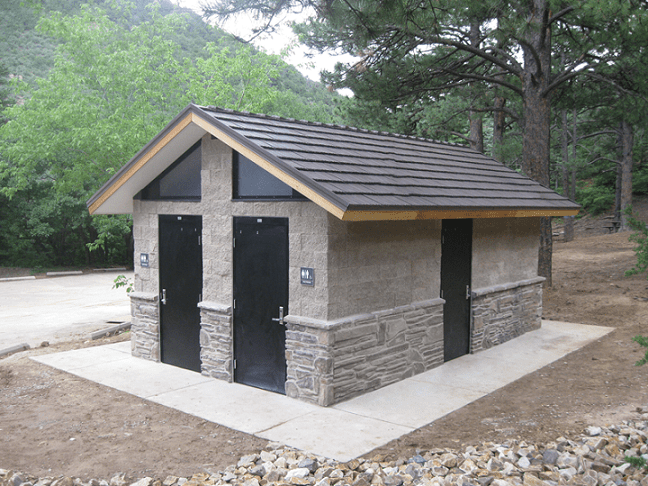
Image credit: romtec.com
A restroom deserves more consideration. There are water and waste disposal specifications, accessibility requirements and security, maintenance and building code requirements. It must also withstand decades of harsh weather and heavy public usage.
Romtec’s design allows the restroom to be a component of a bigger plan and not an added-on.
Prefabricated Buildings don’t have to be Identical
The term prefabricated park restroom buildings can suggest a limited selection of standard structures. A kit-based approach can yield various outcomes.
Romtec creates custom designs and supplies the plans, specifications, engineering documentation as well as building materials to build them. It allows landscape architects to choose the style of architecture and the material that will best fit the needs of the project. Romtec can also provide assistance in navigating codes, ADA regulations, components prices and construction.
For instance, a city that is renovating an historic park may have a different vision for the exterior than a recreation department constructing a new sports complex. Both of them can benefit from an organized building supply process without making the building identical.
City Streets are a New Design Challenge
Restrooms located in dense urban areas are confronted with particular operational issues. The restrooms might be flooded with pedestrians. There are also concerns regarding safety, vandalism and cleanliness.
Romtec’s sidewalk toilets are designed to be easily visible from the outside, allowing the natural monitoring. They also maintain the functionality of a public restroom. Materials that require minimal maintenance and vandal-resistant parts are essential in this instance because repeated repairs can become a significant operation burden for public agencies.
It’s more than just building the best bathroom. Layout, materials and the surrounding environment work together in order to make it easier to maintain.
The most important issue is the underground
Before planning the design of a bathroom, planners should consider the infrastructure that is in place.
It’s possible that a park in a city that was developed in the past had the convenience of water, electric, and sewer lines for sanitary purposes. If you decide to extend these utilities to a remote campsite or trailhead the cost could be an expensive expense.
If the location is suitable, vault toilets provide the option of water-free toilets. Romtec supplies the vault toilets with parts, like its single-piece polyethylene riser. The smooth and molded material is chemical resistant, easy to clean, and specifically designed to stop bacteria growth. It can be installed in existing or new vault restrooms.
Design for People Arriving After Closing Time
Visitors experience a restroom for a brief period of time. Maintenance personnel have lived with the design for years.
This reorientation of perspective is important. It is difficult for surfaces to clean, parts that damage easily, and substances that are not well-suited to repeated cleaning can transform small design decisions into recurring expenses.
Durability and serviceability therefore belong to the initial design discussion along with design and construction costs. Energy-efficient and sustainable materials, eco-friendly systems vandal-resistant fixtures efficient maintenance access could affect the long-term value.
The landscape might still include a small structure
The design of restrooms doesn’t have to compete with the park surrounding it, nor is it necessary to look sloppy.
Romtec’s custom approach gives public agencies and design professionals the opportunity to coordinate restroom facilities that include pavilions, shelters as well as campgrounds, pools trails, and the surrounding architecture. In the same way the practical aspects like ADA accessibility, code compliance, sanitation and durability as well as maintenance are still at the forefront of the overall plan.
When these elements are combined and the result isn’t just a toilet. It’s a public infrastructure specifically crafted for the communities and environments it serves.